




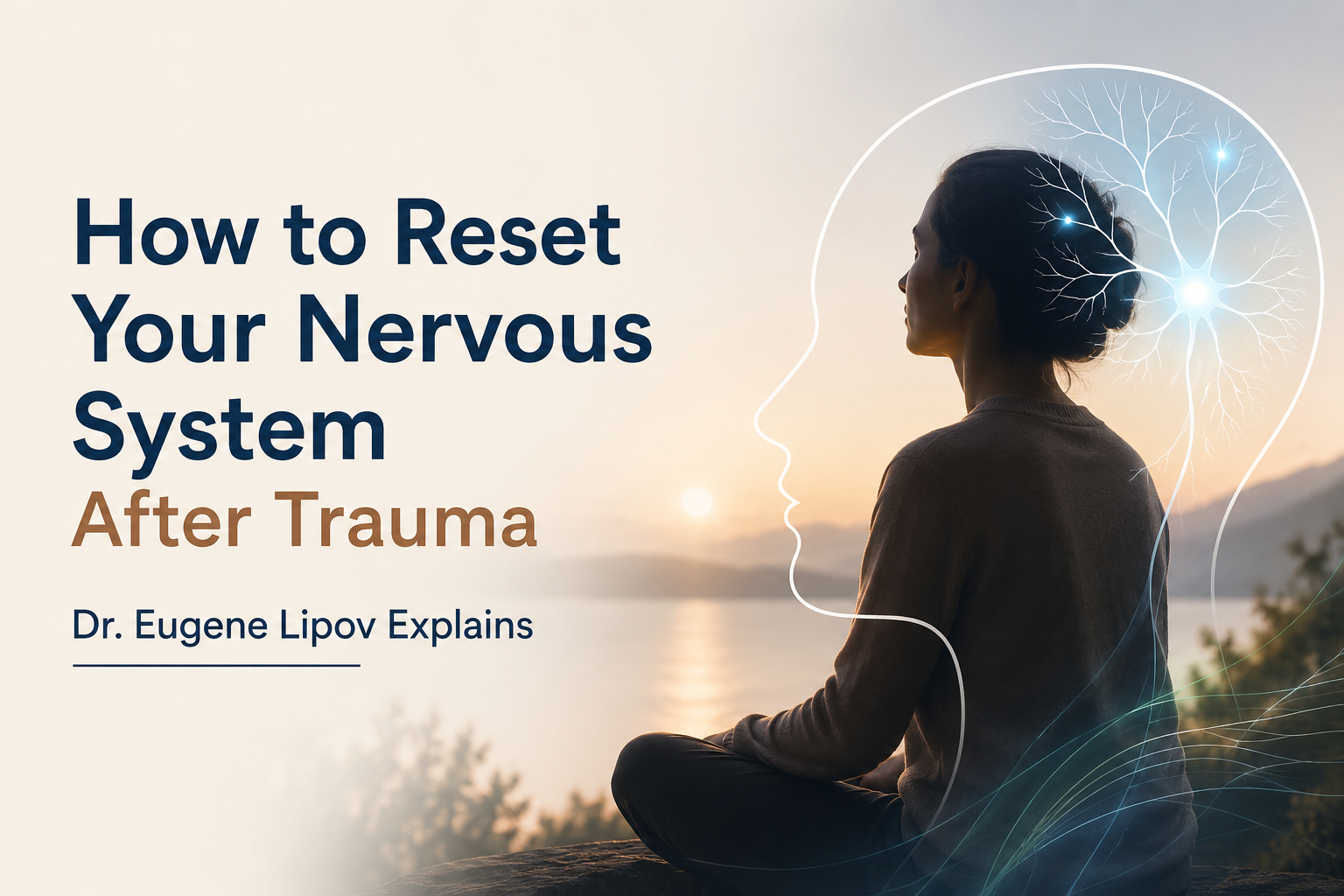
El Dr. Eugene Lipov explica cómo restablecer el sistema nervioso tras un trauma, yendo más allá de los pensamientos y los recuerdos. Para muchas personas, el evento traumático puede haber terminado, pero el cuerpo sigue comportándose como si el peligro persistiera. Quienes han vivido un trauma pueden reconocer esta sensación: la vida sigue adelante, pero una parte del cuerpo parece resistirse a seguirla.
El peligro ha pasado. La relación terminó hace años. El despliegue ha concluido. El accidente solo existe en el recuerdo. Sin embargo, el cuerpo sigue actuando como si algo terrible estuviera a punto de suceder.
El sueño se vuelve superficial. Los ruidos fuertes se perciben con mayor intensidad de lo normal. Una habitación llena de gente de repente resulta agotadora. Incluso los momentos de calma pueden sentirse extrañamente desconocidos.
Es una experiencia frustrante. Y a menudo solitaria.
A la gente se le dice que se relaje, que siga adelante o que piense en positivo. Pero el trauma no siempre reside solo en los pensamientos. A veces se instala en el propio sistema nervioso.
Esta idea ha marcado gran parte del trabajo del Dr. Eugene Lipov, cuya investigación se ha centrado en comprender cómo el trauma afecta al sistema de respuesta al estrés del cuerpo y qué puede ayudar a restablecer el equilibrio cuando ese sistema se bloquea.
¿Qué significa reiniciar el sistema nervioso?
En términos sencillos, restablecer el sistema nervioso significa ayudar al cuerpo a salir de un estado prolongado de supervivencia y volver a un estado de regulación más saludable.
El sistema nervioso está diseñado para proteger a las personas. Esa es su función.
Ante el peligro, el sistema nervioso simpático aumenta la frecuencia cardíaca, agudiza el estado de alerta y prepara al cuerpo para responder. Esta respuesta de “lucha o huida” puede salvar vidas.
El problema surge cuando el sistema no se apaga por completo posteriormente.
Para algunas personas, especialmente después de un trauma significativo, el cuerpo continúa funcionando como si la amenaza siguiera presente. Meses después. A veces, años después.
El resultado puede manifestarse como ansiedad, hipervigilancia, trastornos del sueño, insensibilidad emocional, irritabilidad o una sensación constante de estar "en tensión".“
No es debilidad.
No es un defecto de carácter.
El sistema nervioso está trabajando arduamente para mantenerte a salvo.
El Dr. Eugene Lipov explica cómo restablecer el sistema nervioso después de un trauma.
El trauma afecta a más que solo la memoria.
Las investigaciones han demostrado que las experiencias traumáticas pueden alterar la forma en que el cerebro y el sistema nervioso procesan el estrés. El sistema de alarma del cuerpo se vuelve más sensible y responde a situaciones que ya no representan un peligro real.
Esto ayuda a explicar algo que a mucha gente le resulta confuso.
Comprenden intelectualmente que están a salvo.
Sin embargo, su cuerpo no está de acuerdo.
Un corazón acelerado no siempre atiende a la lógica.
Tampoco lo hace la hiperactivación crónica.
Esa es una de las razones por las que los enfoques tradicionales, si bien suelen ser valiosos, quizás no aborden por completo todos los aspectos de la recuperación del trauma. Las estrategias cognitivas pueden ayudar a las personas a comprender lo sucedido. Pero comprender y regular no siempre son lo mismo.
A veces, el cuerpo también necesita apoyo.
El Instituto Nacional de Salud Mental describe los síntomas relacionados con el trauma como respuestas tanto psicológicas como fisiológicas, lo que subraya la estrecha relación entre el trauma y los sistemas de estrés del cuerpo.
Cómo restablecer el sistema nervioso después de un trauma
No existe una única técnica que funcione para todos.
Esa respuesta suele decepcionar a quienes buscan una solución rápida. Pero la sanación a menudo es más compleja que una simple lista de pasos.
Como explica el Dr. Eugene Lipov, la regulación del sistema nervioso suele implicar una combinación de enfoques en lugar de una única solución. La recuperación tiende a producirse mediante experiencias constantes y de apoyo que ayudan al cuerpo a sentirse seguro de nuevo.
El movimiento suave puede ser beneficioso. Los hábitos de sueño regulares son más importantes de lo que la mayoría de la gente cree. Los ejercicios de respiración profunda pueden reducir la activación del sistema nervioso simpático. Las prácticas de atención plena, cuando son apropiadas, pueden mejorar gradualmente la conciencia de los estados internos.
Incluso actividades sencillas, como dar un paseo al aire libre, pasar tiempo con personas que te apoyan o escuchar música relajante, pueden influir en cómo responde el sistema nervioso al estrés.
La clave es la repetición.
No es la perfección.
El sistema nervioso aprende a través de la experiencia, no mediante lecciones magistrales.
Esta perspectiva refleja un tema recurrente en la recuperación de un trauma. El Dr. Eugene Lipov explica que el cambio duradero suele provenir de ayudar al sistema de respuesta al estrés del cuerpo a pasar gradualmente del modo de supervivencia al modo de regulación.
Sin embargo, algunas personas siguen luchando a pesar de años de esfuerzo. Es ahí donde a veces entran en juego las intervenciones médicas.
Investigación del Dr. Lipov sobre el sistema nervioso y el trauma.
Una de las preguntas centrales que subyacen a la investigación que explica el Dr. Eugene Lipov ha sido sorprendentemente sencilla:
¿Qué ocurre si los síntomas del trauma persisten porque la respuesta de lucha o huida del cuerpo permanece fisiológicamente activada?
Es una cuestión que ha dado lugar a años de investigación sobre el sistema nervioso simpático.
Como explica el Dr. Eugene Lipov, el trauma puede afectar a algo más que pensamientos y recuerdos. En algunos casos, el sistema de respuesta al estrés del cuerpo parece permanecer activado mucho después de que la amenaza original haya desaparecido.
En lugar de analizar el trauma únicamente desde una perspectiva psicológica, el Dr. Lipov exploró si ciertos síntomas también podrían estar relacionados con la activación biológica continua dentro del circuito de estrés del cuerpo.
Esa exploración contribuyó finalmente a un creciente interés por el bloqueo del ganglio estrellado (BGE), un procedimiento que actúa sobre los nervios implicados en el sistema nervioso simpático.
El objetivo no es borrar los recuerdos.
No se trata de olvidar.
En cambio, la idea es ayudar a reducir la intensidad de la respuesta de alarma del cuerpo para que las personas puedan involucrarse más plenamente en otros aspectos de la curación. Como explica el Dr. Eugene Lipov, ayudar al sistema nervioso a regularse de manera más eficaz puede generar oportunidades para una recuperación y resiliencia más amplias.
Para quienes estén interesados en la ciencia que hay detrás de este enfoque, el blog del Dr. Lipov explora con mayor profundidad la relación entre el trauma, la fisiología del estrés y la regulación del sistema nervioso.
¿Qué es un bloqueo del ganglio estrellado (BGE)?
El bloqueo del ganglio estrellado es un procedimiento mínimamente invasivo que consiste en inyectar anestesia local cerca de un grupo de nervios llamado ganglio estrellado.
Estos nervios forman parte del sistema nervioso simpático, la red responsable de activar la respuesta de lucha o huida del cuerpo.
Este procedimiento se ha utilizado durante décadas en el tratamiento del dolor. Más recientemente, investigadores y clínicos han estudiado su posible utilidad para ayudar a personas con síntomas relacionados con traumatismos.
La teoría es relativamente sencilla.
Si el sistema de alarma del cuerpo se ha vuelto hiperactivo, interrumpir temporalmente esa vía de señalización puede ayudar a reducir la activación simpática crónica.
Concepto simple.
Ciencia compleja.
Las investigaciones en curso continúan examinando cómo y por qué algunas personas experimentan una mejoría en sus síntomas después del tratamiento.
Se puede acceder a un creciente conjunto de estudios publicados que examinan el trauma, la fisiología del estrés y la regulación del sistema nervioso a través de Centro Nacional de Información Biotecnológica (NCBI), uno de los mayores repositorios mundiales de investigación biomédica revisada por pares.
¿Quiénes podrían beneficiarse del tratamiento de traumatismos centrado en el sistema nervioso?
No todas las personas que experimentan estrés requieren intervención médica especializada.
Muchas personas experimentan una mejoría significativa a través de la terapia, cambios en el estilo de vida, apoyo social y el paso del tiempo.
Otros no.
Esa distinción es importante.
Aquellas personas que continúan experimentando síntomas persistentes a pesar de haber probado diversos enfoques podrían beneficiarse de consultar con un profesional sanitario cualificado sobre otras opciones.
Esto es especialmente cierto cuando los síntomas interfieren con el sueño, las relaciones, el trabajo o la calidad de vida en general.
El objetivo no es simplemente reducir los síntomas.
Es la posibilidad de volver a sentirnos presentes.
Menos reactivo.
Menos cansado.
Un poco más conectado con la vida.
La curación suele ser menos espectacular de lo que la gente espera.
La cultura popular tiende a presentar la recuperación como un momento decisivo.
Una conversación. Una revelación. Una experiencia transformadora.
La verdadera sanación a menudo se manifiesta de forma diferente.
Una persona nota que duerme toda la noche con más frecuencia.
Un supermercado abarrotado parece manejable.
Sus hombros se relajan sin darse cuenta.
Pequeñas cosas.
Pero cosas significativas.
El sistema nervioso rara vez cambia de la noche a la mañana. Aprende gradualmente, a través de la seguridad, la constancia y, a veces, la combinación adecuada de apoyo terapéutico y médico.
Por eso, las conversaciones en torno a la recuperación del trauma siguen evolucionando.
Investigadores como el Dr. Eugene Lipov han contribuido a ampliar esas conversaciones más allá de los pensamientos y las emociones, llamando la atención sobre el papel que pueden desempeñar los sistemas de estrés del cuerpo en la curación a largo plazo.
Y para muchas personas, ese cambio de perspectiva ofrece algo valioso.
No es una promesa.
No es un milagro.
Es simplemente una forma diferente de entender por qué al cuerpo a veces le cuesta soltar... y qué puede ayudarle a encontrar el camino de regreso.