Research and publications
Peer-reviewed clinical studies and articles published in medical journals. 55 papers since 2005, from the first use of stellate ganglion block for PTSD to today’s work on psychobiology.
All publications
PTSD, TBI and PTSI
Stellate ganglion block (SGB) and dual sympathetic reset (DSR) for post-traumatic stress and traumatic brain injury.
Dr. Lipov on SGB and DSR, 2023 to today
- 2026
Cervical sympathetic block as a modulator of secondary injury mechanisms in traumatic brain injury
- 2026
Stellate ganglion block and sleep disorders: a narrative review
- 2026
Synergistic neuromodulation and stellate ganglion block in depression: a neuroimmune framework
- 2026
Successful treatment of “functional seizures” using cervical sympathetic block
Psychobiology explores how the mind and body influence each other, creating cycles of health or disease.
- 2025
Successful treatment of a PTSD patient with psychosis and dissociative identity disorder using cervical sympathetic block
- 2025
Treating PTSD in Canadian Special Operation Forces Command with ketamine plus cervical sympathetic blockade
- 2024
Updated findings on the efficacy of combined ketamine infusion and cervical sympathetic blockade to treat PTSD/TBI
- 2024
Cervical sympathetic blockade (CSB) produces a 44% reduction of suicidal ideation
- 2024
Ketamine plus CSB likely more effective in reducing the symptoms of PTSD and depression
- 2024
Letter to the editor: retrospective analysis of 23 patients with TBI successfully treated using bilateral, two-level SGB
- 2024
Letter to the editor: reversing increased anxiety following left-sided SGB to treat PTSD
- 2024
Unanticipated elimination of bulimia symptoms after a cervical sympathetic block for treating PTSD
- 2024
An overview of SGB spanning the past three decades: a bibliometric analysis
Dr. Lipov is recognized here as a leading authority in SGB research.
- 2023
Secondary PTSD study
Post-traumatic stress disorder (PTSD) and traumatic brain injury (TBI) with associated headache are amongst the most common injuries sustained by our deployed forces.
- 2023
Successful treatment of a Special Forces soldier with blast TBI and PTSD, with one-year follow-up
- 2023
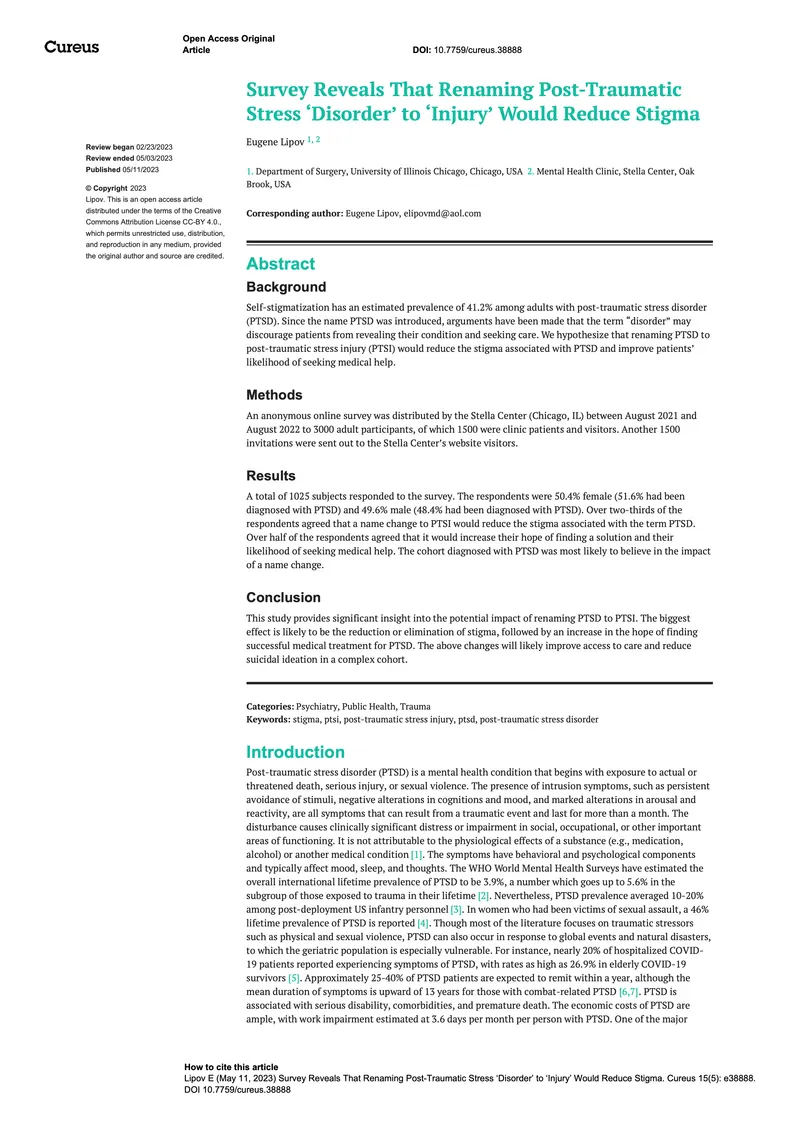
Survey of 3,000 patients shows a name change from PTSD to PTSI would reduce stigma, increase hope and improve access to care
- 2023
Two couples successfully treated with DSR: men with primary PTSD, women with secondary PTSD, documented by brain scans
Dr. Lipov on SGB and DSR, selected before 2023
- 2022
Efficacy of SGB/DSR to treat PTSD/PTSI in 22 types of trauma
- 2021
The real origins of SGB for PTSD
- 2021
Origins of SGB for PTSD, the use of left and right SGB: letter to the editor
- 2020
Effect of SGB on the immune system
- 2017
Possible reversal of changes in DNA related to PTSD/PTSI after SGB
- 2017
SGB for ulcerative colitis
- 2016
Reversal of male sexual dysfunction with PTSD using SGB
- 2015
SGB use in pediatric psychiatric conditions
- 2015
Resistance to pharmaceuticals in treating war-related PTSD paves the way for SGB?
- 2012
Decreased memory dysfunction in patients with co-occurring PTSD/PTSI and excessive alcohol use after SGB
- 2012
Cortisol, SGB and memory
- 2010
Pulsed radiofrequency for PTSD/PTSI
- 2009
Hypothetical explanation of the effect of SGB on PTSD and hot flashes
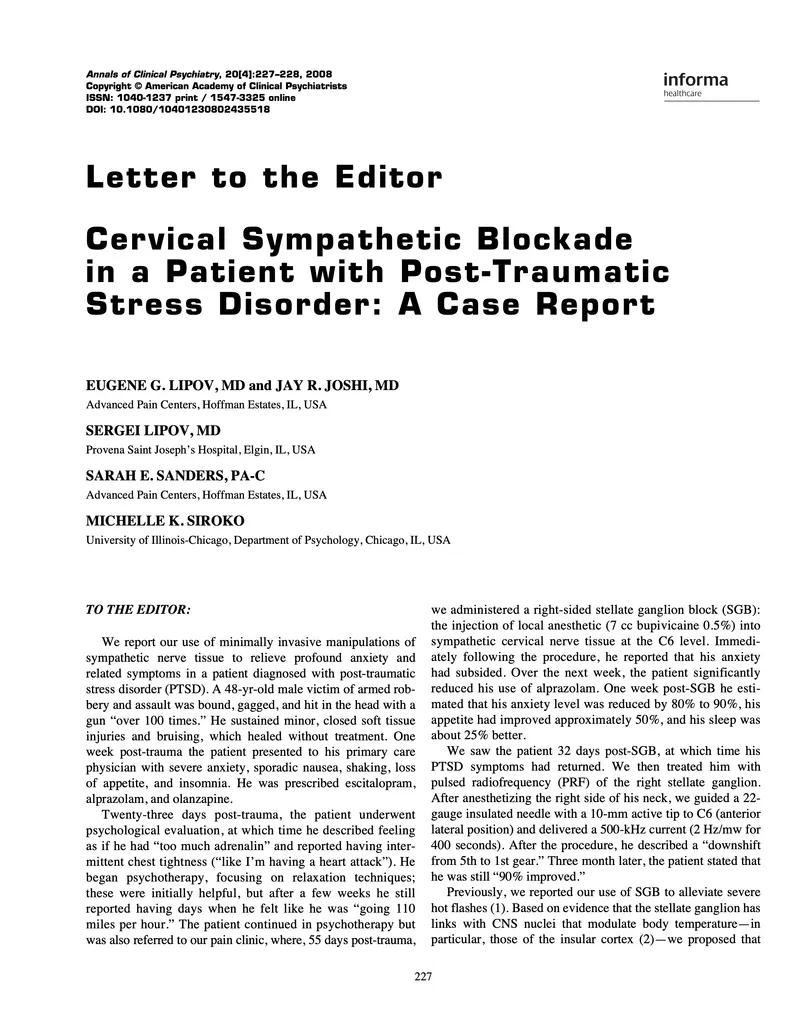
- 2008
First paper to document SGB to treat PTSD: cervical sympathetic blockade in a patient with post-traumatic stress symptoms
Other researchers on SGB and DSR
- 2025
Three-month durability of bilateral two-level SGB in patients with generalized anxiety disorder
- 2024
Stellate ganglion block in disparate treatment-resistant mental health disorders: a case series
- 2024
Ultrasound-guided SGB combined with pharmacological treatment for rosacea
- 2021
Behavioral health clinicians endorse SGB for treatment of trauma-related disorders
- 2019
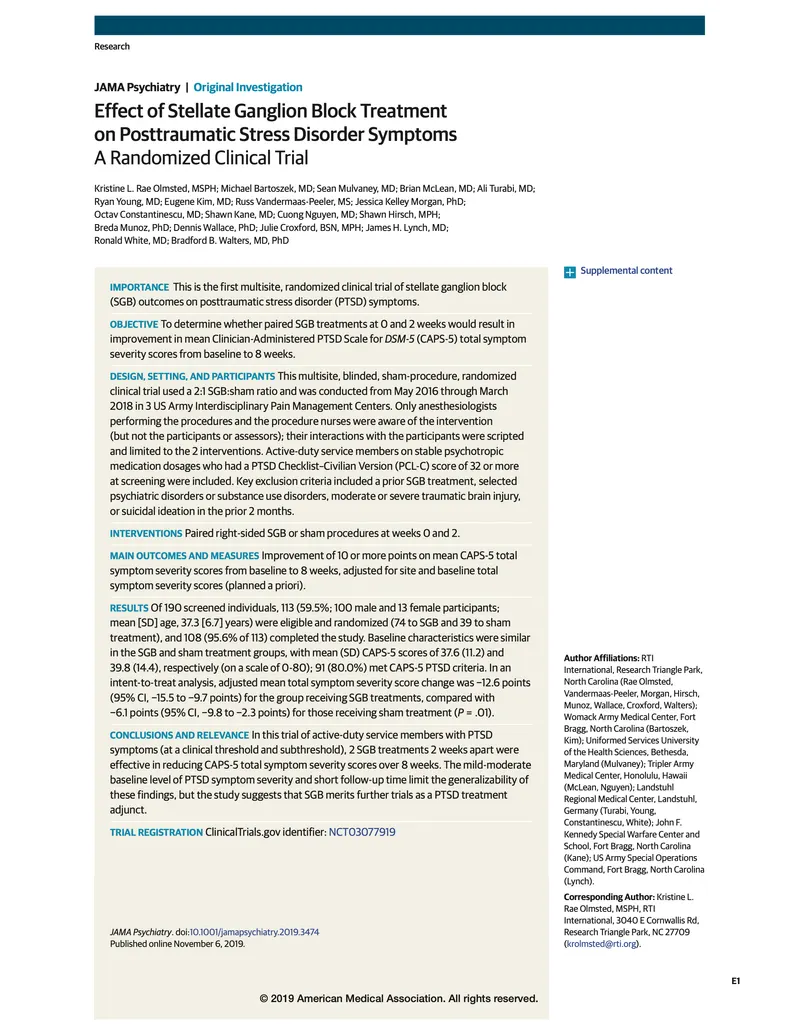
Three-site military study shows SGB twice as effective as placebo
- 2017
Official VA position on SGB for PTSD/PTSI
- 2016
Johns Hopkins review of SGB to treat PTSD
- 2015
Long Beach VA brain scans before and after SGB show reversal of PTSD/PTSI
- 2014
Large follow-up study of 166 patients with PTSD/PTSI treated by SGB
- 2013
First description of the effect of SGB on a suicidal patient
Active studies
- 2023
Stella study: reversal of the biological (and aging) effects of PTSD/PTSI by DSR
- 2021
NYU Langone Health examines brain scans before and after DSR
- 2021
Initial conclusions find SGB an attractive therapeutic modality for long COVID
Menopause and hot flashes
SGB as a non-hormonal treatment for hot flashes, including in survivors of breast cancer.
Dr. Lipov on SGB for hot flashes
- 2011
Stellate ganglion block (SGB) to treat perimenopausal hot flashes: clinical evidence and neurobiology
Hot flashes are the most common symptom of menopause, affecting approximately 80% of perimenopausal women in Western societies. Their effects are even more acute and debilitating among breast cancer survivors… Thus, millions of American women await the arrival of new options to provide effective relief for perimenopausal hot flashes.
- 2008
Lancet Oncology publishes updated findings on SGB for hot flashes and night awakenings in survivors of breast cancer
- 2008
Lancet Oncology pilot study
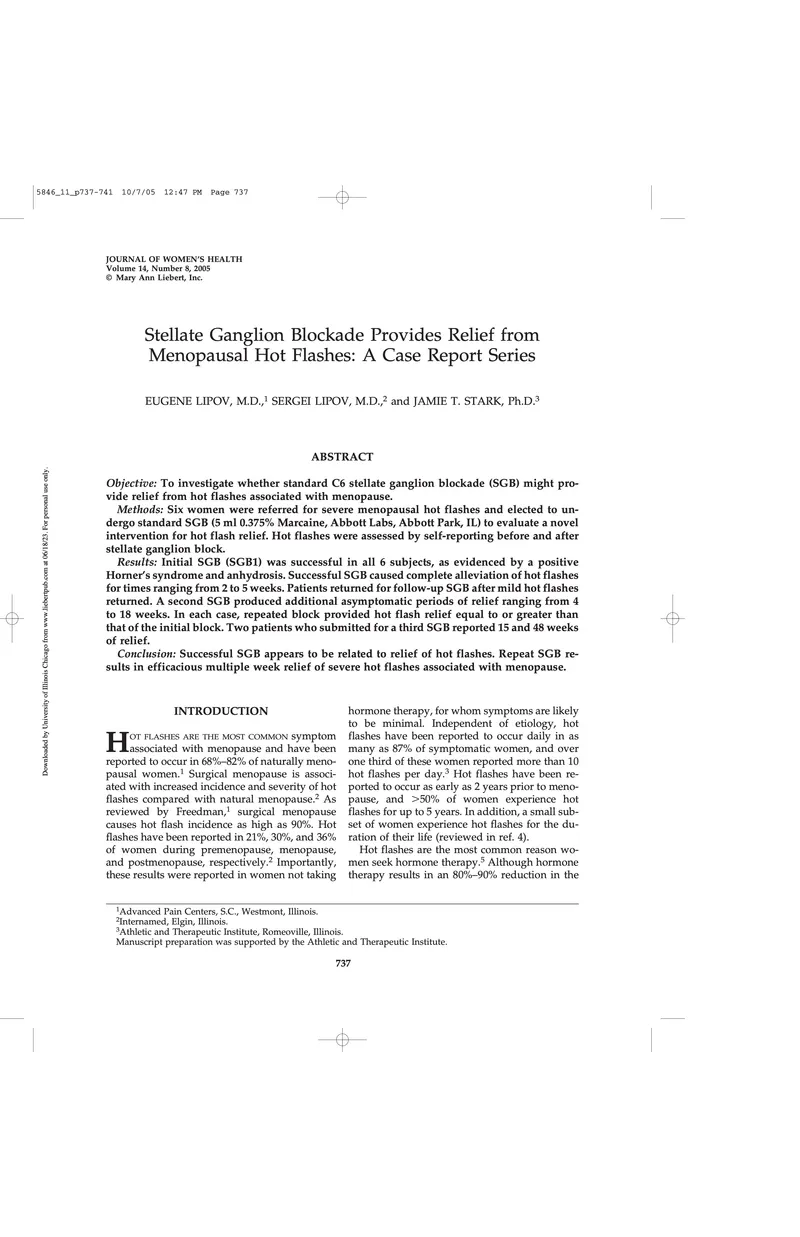
- 2005
First documentation of SGB to treat hot flashes
Other researchers on SGB for hot flashes
- 2022
Stellate ganglion block as a treatment for vasomotor symptoms: clinical application
Cleveland Clinic Journal of Medicine
Vasomotor symptoms, also called hot flashes, hot flushes, and night sweats, are common during the menopause transition. Severe symptoms can substantially decrease quality of life. The authors first review current hormonal and nonhormonal therapies, then review evidence supporting the potential use of stellate ganglion block for managing vasomotor symptoms in perimenopausal and postmenopausal women.
- 2014
Effects of stellate ganglion block on vasomotor symptoms in postmenopausal women
Northwestern University, Menopause
SGB may provide effective treatment of VMS in women who seek nonhormonal treatments because of safety concerns and personal preference. The finding that SGB significantly reduces objectively measured VMS provides further evidence of efficacy. A larger trial is warranted to confirm these findings.
- 2009
Pilot evaluation of a stellate ganglion block for the treatment of hot flashes
Mayo Clinic, Supportive Care in Cancer
The results of this pilot trial support that stellate ganglion blocks may be a helpful therapy for hot flashes. A prospective placebo-controlled clinical trial should be done to more definitively determine this contention.
- 2009
Pilot study of SGB for hot flushes and night sweats in breast cancer patients
Cancer Research, 2009 supplement
This pilot and prospectively planned study to test efficacy of SGB on hot flushes and/or night sweats confirmed that breast cancer patients suffering from invalidating symptoms may benefit with no short term harm.
Digital toxicity
Where the biology of trauma meets constant digital exposure.
Reviews
- 2026
Health effects of problematic smartphone use and evidence-based mitigation strategies: a narrative review
- Submitted
Shared neurobiological pathways in post-traumatic stress disorder and chronic digital exposure: a scoping review
Submitted to Cyberpsychology, Behavior, and Social Networking. The review examines overlapping biological mechanisms between PTSD and chronic digital exposure, including stress-system dysregulation, autonomic nervous system changes, sleep disruption, inflammation, and brain-network effects.
Hormone replacement therapy
Hormones as part of a wider neuro-immune-endocrine picture.
Reviews
- 2026
Testosterone: a missing biological link in morbidity and mortality among U.S. veterans
Testosterone deficiency is better understood as a central element of a broader neuro-immune-endocrine dysregulation than as a standalone hormonal problem. A structured approach to screening, diagnosis, and longitudinal management within the Veterans Health Administration may offer a high-impact strategy to improve clinical outcomes and reduce healthcare utilization.
No paper matches that search. Try a shorter word.