



There’s a certain kind of exhaustion that doesn’t show up on scans.
People carry it quietly on their shoulders. In the way they scan rooms, sleep never quite feels like sleep.
For years, most conversations around trauma stayed in the realm of therapy and medication. Important, necessary, often life-changing. And yet… not always enough. Some people do everything “right” and still feel like their body hasn’t received the memo that the danger is over.
That’s where something like a stellate ganglion block for PTSD starts to feel less like a fringe idea… and more like a missing piece. A different way of looking at the same struggle. One that doesn’t just ask the mind to heal, but gently nudges the body to finally stand down.
What Is Stellate Ganglion Block, Really?
The name sounds more complicated than the concept.
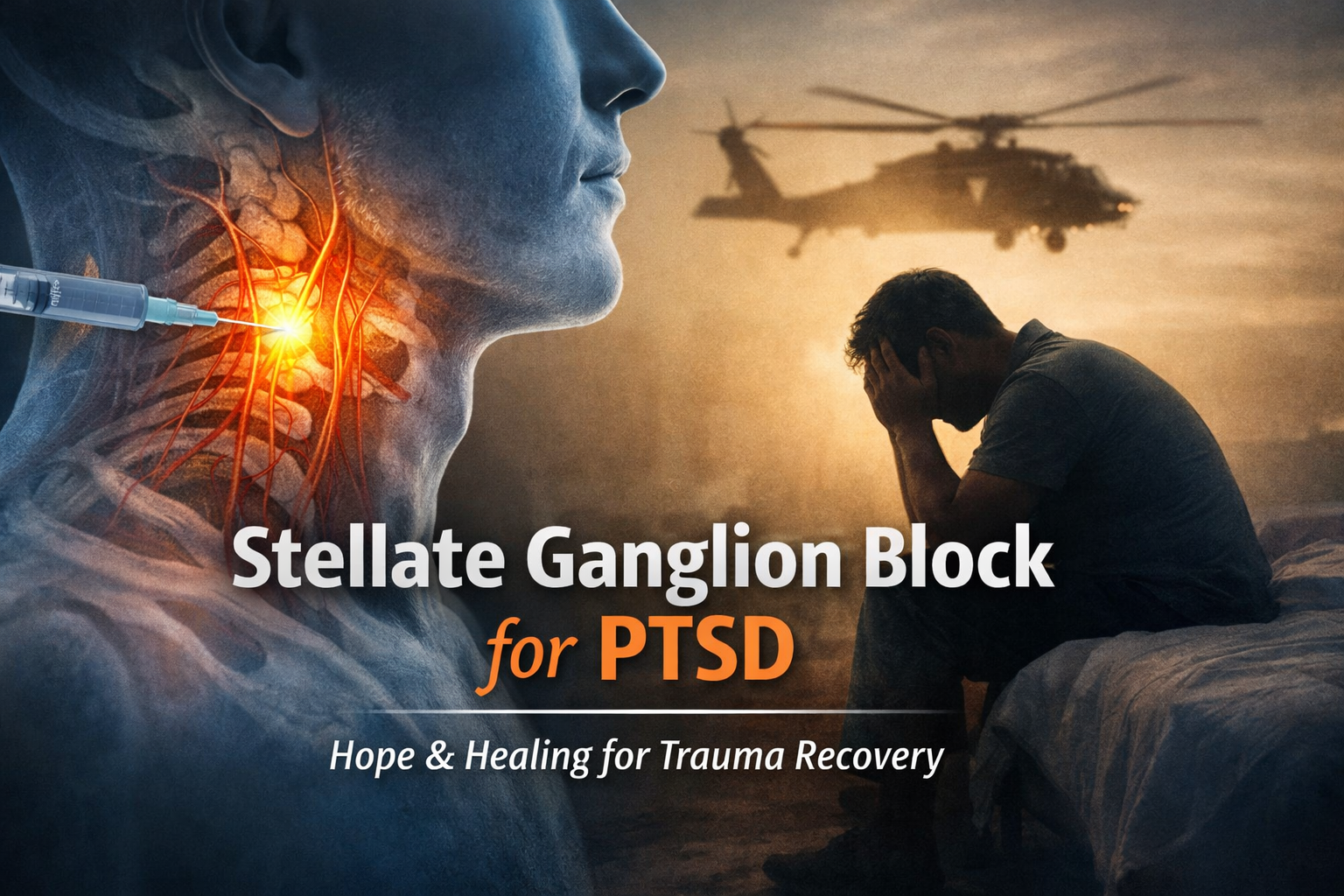
A stellate ganglion block, often shortened to SGB, is a medical procedure that involves injecting a local anesthetic into a cluster of nerves in the neck. These nerves are part of the sympathetic nervous system, the system responsible for that familiar fight-or-flight response.
Now here’s the part people tend to pause at.
PTSD isn’t just a memory problem. It’s often a body problem. The nervous system gets stuck in a loop, reacting as if the threat is still present, even when it isn’t.
SGB doesn’t “erase” trauma. It doesn’t touch memory in that way. What it seems to do, in many cases, is quiet that overactive alarm system.
Almost like lowering the volume on something that’s been blaring for too long.
There’s a calm that follows for some patients. Not dramatic. Not cinematic. Just… noticeable.
How Does Stellate Ganglion Block Work?
It’s tempting to expect a neat, clinical explanation. Cause, effect, done.
But the human nervous system doesn’t always cooperate with tidy explanations.
The working theory is this: by numbing the stellate ganglion temporarily, the procedure disrupts the cycle of heightened sympathetic activity. In simpler terms, it gives the nervous system a chance to reset its baseline.
Stress hormones like norepinephrine, which tend to stay elevated in chronic trauma, may drop. The body, for the first time in a while, isn’t bracing for impact.
And that shift… even if subtle… can change how someone experiences daily life.
Sleep becomes less fragmented. Reactions soften. That constant edge dulls just enough to breathe.
It’s not magic. But it can feel like relief.
For a deeper medical overview of the procedure and its applications, resources like the Cleveland Clinic provide a grounded, clinical explanation of how nerve blocks function within pain and neurological care.
Is Stellate Ganglion Block Safe?
This is usually where the conversation turns more cautious. And it should.
Any procedure involving the neck sounds intimidating at first. That’s a natural reaction.
SGB has actually been used for decades, primarily for pain management conditions. In that context, it has a relatively strong safety profile when performed by trained specialists.
Common side effects can include temporary hoarseness, drooping of the eyelid, or a warm sensation on one side of the face. These typically resolve within hours.
Serious complications are rare, but not impossible. Which is why practitioner experience matters. A lot.
And this is where nuance comes in.
SGB for PTSD is still considered an emerging treatment. It hasn’t replaced traditional therapies. It’s not meant to. Think of it more as an additional tool. One that may help certain individuals, especially when other approaches haven’t fully worked.
Organizations like the U.S. Department of Veterans Affairs have explored SGB in clinical settings, particularly for veterans, though research is ongoing and conclusions are still evolving.
So yes, it can be safe. But it should always be approached thoughtfully, not impulsively.
What Is Dual Sympathetic Reset (DSR)?
If SGB is the foundation, Dual Sympathetic Reset builds on top of it.
Instead of a single injection, DSR involves two treatments, often administered on consecutive days. The idea is to create a more sustained effect on the nervous system.
Some patients who don’t experience full relief from one block may respond better to this dual approach.
It’s not entirely surprising when you think about it. The nervous system, especially one shaped by prolonged stress, rarely shifts in a single moment. Sometimes it needs reinforcement. A second nudge.
DSR isn’t universally standardized yet, and like SGB, it sits in that space between promising and still being understood.
But it’s gaining attention. Quietly, steadily.
For more insight into how these approaches are being used in trauma-focused care, clinics like Stella Center outline patient experiences and evolving treatment protocols.
Why This Feels Different From Traditional PTSD Treatments
There’s something subtle but important happening here with the stellate ganglion block for PTSD.
Most PTSD treatments ask the mind to process what happened. To revisit, reframe, and eventually release.
SGB and DSR approach it from the opposite direction.
They start with the body.
And for some people, that shift matters more than expected.
Because if the body is constantly signaling danger, the mind has very little room to do its work. It’s like trying to have a calm conversation in a room where an alarm keeps going off.
Turn the alarm down, even slightly, and suddenly… other forms of healing have space to work better. This is where the stellate ganglion block for PTSD begins to feel less like an alternative and more like a support system for deeper recovery.
This doesn’t make one approach superior to the other. It just makes them complementary.
So… Is Stellate Ganglion Block for PTSD a Real Breakthrough?
That word gets used too easily.
Breakthrough. Game-changer. Miracle.
Real healing tends to be quieter than that. Less dramatic. More gradual.
SGB and Dual Sympathetic Reset might not be a universal solution, but the stellate ganglion block for PTSD is quietly shifting the conversation. Moving trauma out of a purely psychological box and into a more integrated understanding of mind and body, something also being explored in clinical settings by organizations like the U.S. Department of Veterans Affairs.
And maybe that’s the real shift.
Not a cure. Not a miracle.
But a widening of options.
For someone who has tried everything and still feels stuck, even a small shift in the nervous system can open a door that didn’t exist before. This is where the stellate ganglion block for PTSD begins to feel less like a last resort and more like a different path forward.
And sometimes, that’s enough to begin again.
For those who feel like they’ve tried everything and are still searching for something that actually shifts the weight, it might be worth exploring what options are out there. Sometimes, even a quiet conversation can open new doors.