




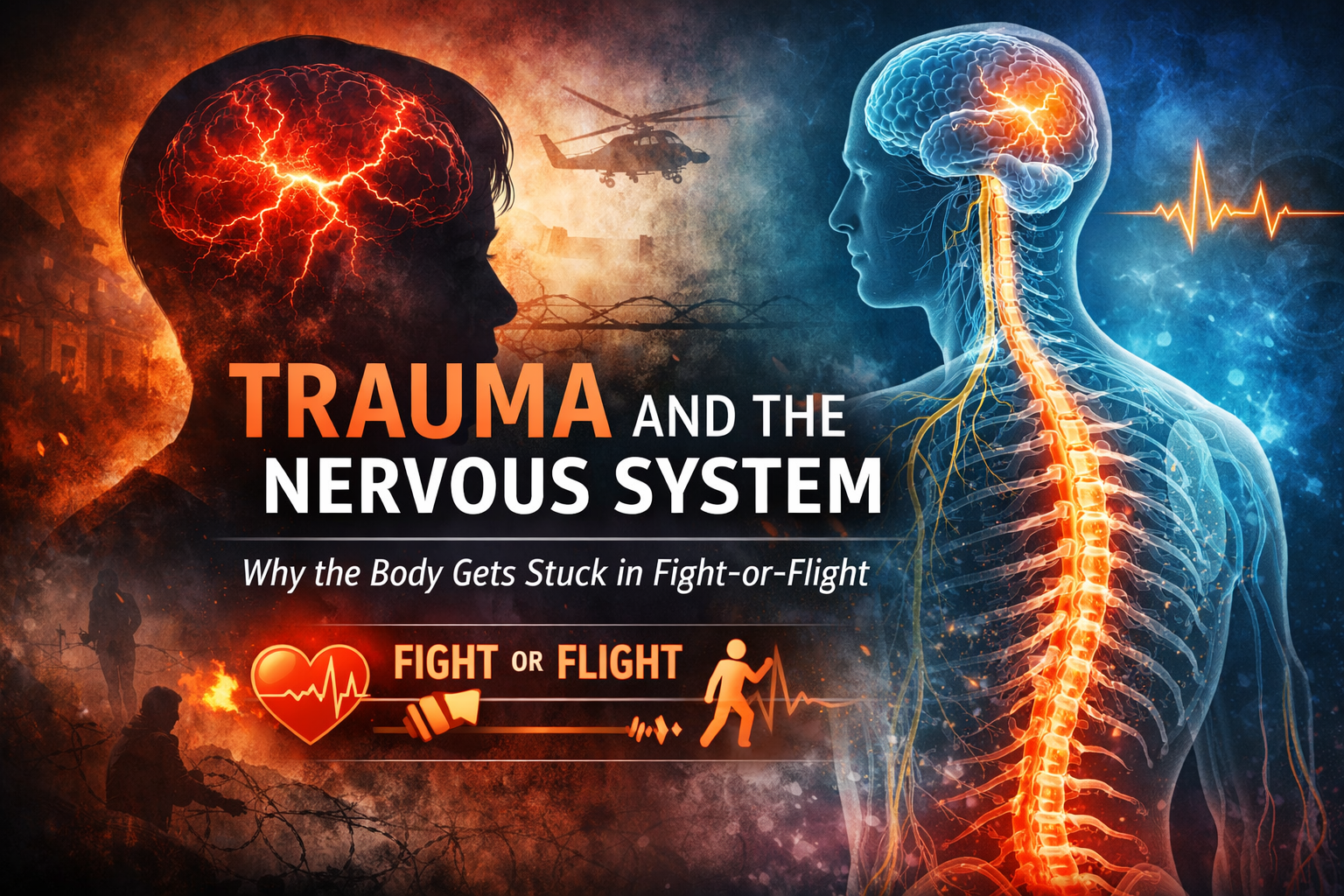
Trauma and the nervous system have a complicated relationship. Something strange happens after trauma.
The event may pass. The room becomes quiet again. Days move forward. Life continues doing what life does — errands, conversations, sunlight through a kitchen window.
And yet… the body doesn’t always get the memo.
For many people, the nervous system keeps behaving as if the danger is still happening. Muscles remain tight. Sleep grows thin. Small noises feel sharp. The mind scans rooms, faces, possibilities. Always a little alert. Sometimes very alert.
This lingering fight or flight response trauma pattern isn’t weakness or imagination. It’s biology trying — somewhat clumsily — to protect.
To understand why that happens, it helps to look at the deeper relationship between trauma and the nervous system.
When the Brain Pulls the Alarm
The human nervous system evolved for survival, not comfort.
When the brain detects danger, it activates the autonomic nervous system. Specifically, the sympathetic branch is the system responsible for the classic fight-or-flight response. Heart rate increases. Breathing becomes faster. Muscles prepare to move. Attention narrows.
For short-term threats, this system works beautifully.
A sudden loud sound. A near accident. A moment of genuine danger. The body mobilizes quickly and then, once the threat disappears, gradually returns to baseline.
But trauma changes the equation.
In traumatic experiences — particularly repeated or overwhelming ones — the brain sometimes recalibrates its internal alarm system. The nervous system begins interpreting ordinary stimuli as possible threats.
A door slamming. A crowded room. A tone of voice.
The body reacts first. The mind tries to catch up later.
This is the nervous system’s response to trauma in action.
Sometimes it becomes so persistent that people describe feeling “stuck” in survival mode — as if the body refuses to switch off the alarm.
The Autonomic Trauma and Nervous System
The autonomic nervous system trauma response operates through two primary branches.
The sympathetic system accelerates things — heart rate, vigilance, adrenaline. It’s the system of action and defense.
The parasympathetic system, meanwhile, slows things down. It supports rest, digestion, and recovery. A quiet return to safety.
In healthy cycles, these systems move like a gentle pendulum. Activation followed by recovery. Effort followed by rest.
Trauma disrupts that rhythm.
Instead of a pendulum, the system can become locked in one direction — usually toward hyper-activation. The sympathetic branch stays engaged long after the original threat has passed.
It’s not uncommon for trauma survivors to experience:
- persistent hypervigilance
- difficulty relaxing
- heightened startle responses
- sleep disturbances
- racing thoughts
All signs that the nervous system still believes something is wrong.
And in a way, from the body’s perspective, caution feels safer than relaxation.
The Quiet Role of the Vagus Nerve
Within this conversation about the vagus nerve and trauma, an important piece of anatomy appears: the vagus nerve.
It runs from the brainstem through the body, connecting organs, regulating heart rate, influencing breathing, and helping the body move back into calm states.
In simplified terms, the vagus nerve acts like a braking system for the stress response.
But trauma can interfere with that brake.
If the nervous system repeatedly experiences overwhelming stress signals, the vagal pathways responsible for restoring calm may struggle to counterbalance the sympathetic activation. The result is a body that remains physiologically prepared for danger — even during ordinary daily life.
Sometimes the nervous system becomes so accustomed to high alert that calm itself begins to feel unfamiliar.
Almost suspicious.
Why the Body Doesn’t Simply “Move On”
One of the more frustrating realities of trauma recovery is that insight alone rarely resets the nervous system. Understanding trauma and the nervous system intellectually is one thing; helping the body feel safe again is something else entirely.
A person may fully understand that a situation is safe. Rationally, everything makes sense.
But the body still reacts.
That’s because trauma often embeds itself in deeper neural circuits — systems responsible for automatic regulation rather than conscious decision-making. The relationship between trauma and the nervous system runs deeper than conscious thought.
The body learned something powerful during the traumatic event:
Stay alert. It keeps you safe.
And so it keeps doing exactly that.
Even when the threat has disappeared.
Research increasingly frames post-traumatic stress not purely as a psychological condition but as a biological disruption in trauma and the nervous system — a shift in how the body regulates stress and safety signals. A deeper exploration of this idea appears in an article discussing PTSD as a nervous system injury, which explains how trauma reshapes threat detection in the brain and body.
https://dreugenelipov.com/ptsd-nervous-system-injury
Understanding trauma this way can feel oddly relieving.
Because it reframes the experience.
Not broken.
Not weak.
Just a nervous system trying too hard to protect.
When the Stress System Becomes Dysregulated
Over time, persistent fight-or-flight activation can lead to what clinicians often call nervous system dysregulation.
In this state, the body struggles to shift smoothly between stress and calm.
Some days the system is overactive — restless, anxious, reactive. Other days, it may swing toward exhaustion or shutdown.
Neither extreme feels stable.
A deeper explanation of these patterns appears in an article examining the symptoms of a dysregulated nervous system, including why chronic stress can alter the body’s baseline response to everyday stimuli.
https://dreugenelipov.com/dysregulated-nervous-system-symptoms
Reading through those patterns often brings a moment of recognition for many people.
Not because the symptoms are new.
But because, suddenly, they make sense.
Can the Nervous System Reset?
The encouraging part of this conversation is that nervous systems are adaptable.
They learned survival patterns through experience, which means they can gradually learn safety as well.
Healing often involves helping the body re-experience states of regulation. Slowly. Repeatedly. In small ways.
Therapeutic approaches may focus on breath regulation, body awareness, trauma-informed psychotherapy, and nervous system retraining. Research from the National Institute of Mental Health explains how trauma can alter the brain’s stress response and nervous system regulation, offering deeper insight into why recovery often involves both psychological and physiological healing.
www.nimh.nih.gov/health/topics/post-traumatic-stress-disorder-ptsd
More recently, some medical treatments aim to directly address the physiological stress response by targeting the sympathetic nervous system itself. One such approach is described in the explanation of Dual Sympathetic Reset, a treatment designed to calm the overactive fight-or-flight response associated with trauma.
www.dreugenelipov.com/dual-sympathetic-reset-ptsd-treatment
These interventions reflect a broader shift in trauma science: recognizing that trauma lives not only in memory but also in the nervous system’s wiring.
And sometimes the body needs help remembering how to relax.
A Body That Is Trying to Protect
Perhaps the most important realization in all of this is a compassionate one.
The body stuck in fight-or-flight isn’t malfunctioning.
It’s protecting.
The nervous system learned something during trauma — that vigilance increases survival. And so it continues the behavior, long after the original threat has faded into the past.
Understanding trauma and the nervous system through this lens changes the conversation.
Instead of asking, “Why can’t the body just calm down?”
A better question emerges.
What does the nervous system still believe it needs to stay safe?
From there, healing becomes less about forcing relaxation and more about gently teaching the body that safety can exist again.
Not overnight.
Not perfectly.
But gradually — breath by breath, moment by moment — the alarm system can learn something new.
That the danger has passed.
And that it is finally allowed to rest.