
There’s a strange kind of loneliness that can follow a frightening medical experience.
Not always dramatic. Not always obvious.
Sometimes it begins quietly, after a difficult surgery, an ICU stay, a painful procedure, or even a moment where the body simply stops feeling safe. People go home, technically “treated,” but something underneath remains unsettled. Sleep changes. The nervous system becomes jumpy. Hospital smells trigger panic. A routine doctor’s appointment suddenly feels impossible.
And because medicine often focuses on survival first, emotional aftershocks can get brushed aside. Understandably so. But still.
The body remembers things the mind tries very hard to move past.
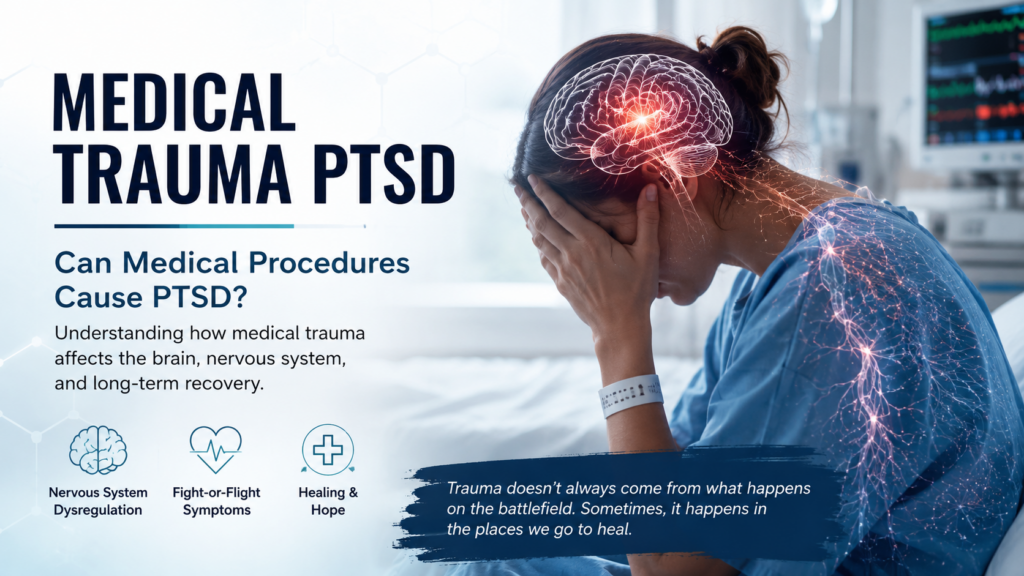
What Is Medical Trauma PTSD?
Yes, medical procedures can cause PTSD. Or symptoms that look very much like it.
Medical trauma PTSD refers to trauma responses that develop after distressing healthcare experiences — surgeries, emergency procedures, chronic illness treatment, ICU stays, childbirth complications, severe pain episodes, or even repeated invasive testing. The nervous system interprets these experiences as threats, sometimes long after the physical event has ended.
According to the U.S. Department of Veterans Affairs PTSD Center, trauma is not limited to combat or violence. Any event involving fear, helplessness, pain, or perceived danger can deeply affect the brain and body.
That surprises people more often than it should.
A patient can be surrounded by skilled doctors, advanced equipment, fluorescent lights, and still leave emotionally shattered. Human nervous systems are not especially logical in moments of overwhelm. They’re protective. Primitive. Fast.
Sometimes, a ventilator alarm at 3 a.m. is enough to wake the body into survival mode.
Why the Nervous System Can Stay “Stuck” After Medical Trauma
The short version? The body learns danger faster than it learns safety.
After traumatic medical experiences, the sympathetic nervous system — the system responsible for fight-or-flight responses — can become overactive. Heart rate rises too easily. Sleep becomes shallow. Hypervigilance settles in quietly, like static in the background of everyday life.
People often describe it in oddly similar ways:
“I can’t relax anymore.”
“My body feels tense all the time.”
“It’s like something bad is about to happen.”
Even when life is technically calm.
Research from the National Institute of Mental Health explains that PTSD symptoms involve changes in how the brain processes fear, memory, and threat detection. But honestly, outside medical language, it often feels simpler than that.
The nervous system just forgets how to stand down.
And medical trauma carries a particular emotional complexity because the threat often came during moments of vulnerability. The body was already compromised. Trust was required. Control was limited.
That matters psychologically. Probably more than healthcare systems sometimes realize.
Signs of PTSD After Medical Procedures
Medical trauma PTSD does not always appear immediately. Sometimes symptoms surface weeks or months later, once the body finally has room to process what happened.
Common signs can include:
- Panic before medical appointments
- Flashbacks or intrusive memories
- Sleep disturbances or nightmares
- Emotional numbness
- Hypervigilance symptoms
- Sudden anxiety around hospitals or medical settings
- Difficulty trusting healthcare providers
- Feeling detached from the body
- Persistent fight-or-flight symptoms
Not everyone meets the full criteria for PTSD, of course. But even subclinical trauma responses can significantly affect quality of life.
That’s the part people underestimate.
A person may look “fine” on paper while internally living in a constant state of alertness. Smiling during conversations. Answering emails. Buying groceries. Meanwhile, the nervous system behaves as if danger is still unfolding somewhere nearby.
Exhausting, really.
Certain Medical Experiences Carry Higher Trauma Risk
Some healthcare experiences are more strongly associated with trauma symptoms than others.
ICU stays are one example. Patients who experience prolonged sedation, mechanical ventilation, or near-death events sometimes report fragmented but deeply distressing memories afterward. Trauma after childbirth complications is another area receiving increasing attention. Cancer treatment can also create long-term nervous system distress, especially when repeated procedures and uncertainty stretch over months or years.
And then some experiences appear “routine” medically but feel terrifying personally.
A child was held down during procedures.
A patient woke unexpectedly during surgery.
A moment where severe pain was dismissed.
A frightening diagnosis delivered too abruptly.
Tiny moments, maybe. But the nervous system does not grade trauma the way spreadsheets do.
Can PTSD From Medical Trauma Be Treated?
Yes. And importantly, treatment is not only about “talking through emotions.”
Trauma lives in the nervous system as much as the conscious mind. Sometimes more.
Traditional PTSD treatment may involve trauma-informed therapy, EMDR, mindfulness-based approaches, medication support, or nervous system regulation techniques. Increasingly, clinicians are also exploring interventions aimed directly at calming the body’s fight-or-flight response.
That connection between trauma and the autonomic nervous system sits at the center of much of Dr. Eugene Lipov’s work.
One approach discussed on the site is the Stellate Ganglion Block (SGB), a procedure designed to help interrupt chronic sympathetic overactivation associated with PTSD symptoms. The idea is not about erasing memories. It’s more nuanced than that.
The goal is to help the nervous system stop reacting as though the trauma is still happening right now.
For some patients, that distinction changes everything.
Why Medical Trauma Often Goes Unrecognized
Partly because survival gets celebrated first.
A successful surgery is considered a success. A patient discharged from intensive care is considered fortunate. And they are. Absolutely.
But emotional recovery does not always move at the same speed as physical recovery.
There’s also a quiet cultural expectation that patients should feel grateful after treatment, even when parts of the experience felt frightening or dehumanizing. Many people minimize their own distress because they assume trauma only “counts” under extreme circumstances.
That belief causes unnecessary suffering.
Trauma is not a competition. Nervous systems are individual. Two people can experience the same procedure and leave with entirely different emotional outcomes. According to the American Psychological Association’s overview on trauma, trauma responses can vary significantly based on personal history, perceived danger, stress levels, and nervous system sensitivity, which helps explain why one medical experience may feel manageable for one person and deeply destabilizing for another.
Neither response is wrong.
When to Seek Help for Medical Trauma PTSD
If trauma symptoms begin interfering with sleep, relationships, work, or basic feelings of safety, it may be time to seek support.
Especially if:
- Medical settings trigger panic
- The body feels persistently on edge
- Fear reactions seem disproportionate
- Avoidant behaviors are growing
- Emotional numbness lingers long after recovery
Early intervention matters. Chronic nervous system activation can slowly reshape daily life in ways that become harder to notice over time, especially for people living with Medical Trauma PTSD.
People adapt to survival mode surprisingly well. Until they realize they haven’t truly relaxed in years. The body stays tense, alert, waiting for another emergency that may never come.
That realization can feel both painful and oddly hopeful.
Because once Medical Trauma PTSD is recognized for what it is, a nervous system response to overwhelming healthcare experiences, treatment becomes possible, too. Recovery may not happen all at once. Usually it doesn’t. But the nervous system can learn safety again, little by little.
Healing Often Begins With Feeling Safe Again
For many people recovering from medical trauma PTSD, healing does not start with dramatic breakthroughs.
It starts smaller.
One full night of sleep.
One doctor’s appointment without panic.
One moment where the shoulders unclench unexpectedly.
Tiny signals of safety returning to the body.
And that’s worth paying attention to. The nervous system notices safety gradually, almost cautiously at first. But it does notice.
Which means trauma responses are not necessarily permanent. Even when they feel deeply ingrained.
Sometimes the body just needs help remembering that the emergency has already ended. Treatments focused on calming the nervous system, including approaches like Stellate Ganglion Block (SGB), are increasingly being explored for people struggling with persistent trauma responses after overwhelming medical experiences.