

Find ways to test how your body is aging and how to improve your biological age.
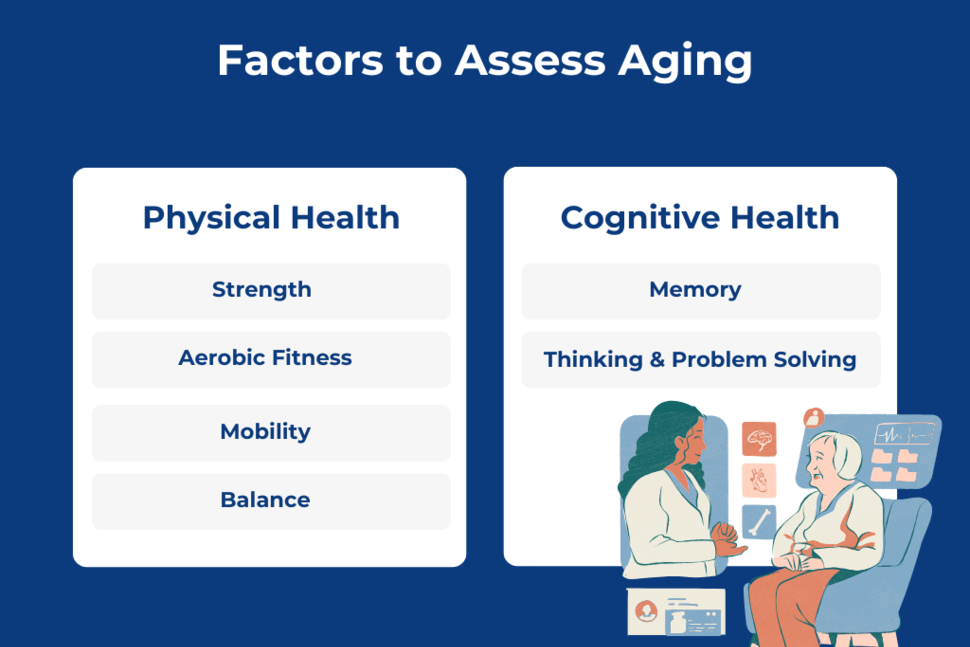
There are a number of tests and activities you can do to get an assessment of your overall well-being and biological age in comparison to your chronological age.
Key takeaways
Have you ever met someone in their 60s who looks 42? Or, maybe that person is you. Some people maintain great health well into their later years of life. This can be a result of genetics, lifestyle factors or socioeconomic factors that enable someone to have a lower “biological age” than chronological age. Biological age is a number calculated based on your health status, whereas chronological age is based on how many years old you are.
“Chronological age is the progress of time, and you can’t change that,” says Dr. Eugene Lipov, Chief Medical Officer at Stella Mental Health, who is also an expert in post-traumatic stress disorder treatment, board-certified in anesthesiology and pain medicine and a longevity researcher. “Biological age is how fast your body is aging. You can reverse your biological age, which is amazing.”
Various tests are available to help you determine what your biological age is, and – if your biological age is not the number you hope to see – various training activities are available to help you improve it. Below, explore factors that influence your biological age, how to find out what your number is and how to make improvements to help you age well.
Your biological age is a number that reflects the health status of your body. More specifically, it sums up the amount of cellular damage you’ve accumulated throughout your life. Many doctors and researchers say biological age paints a more complete picture of how well you’re aging rather than your chronological age. Key factors that influence biological aging include:
To determine how well you are aging, there are a number of tests and activities you can do to get an assessment of your overall well-being and biological age in comparison to your chronological age.
Aging well implies that you are “able to live life, be happy and be strong in work and play,” says Dr. Bert Mandelbaum, a sports medicine specialist, orthopedic surgeon and codirector of the Regenerative Orthobiologic Center at Cedars-Sinai Board of Governors Regenerative Medicine Institute in Los Angeles.
The concept of aging well takes into account the overall quality of life, and having a low biological age can imply that you are aging well. If you are unsure whether or not you are aging well, Mandelbaum recommends starting with a quick lifestyle scan, such as taking a moment to think about ways you may be helping or hurting your health on a daily basis.
For instance, think about if you are supporting your body through regular physical activity, proper nutrition and adequate rest. If you notice that you are not doing these things, consider prioritizing daily movement, a nourishing diet and quality sleep to feel and age better. Additionally, if you notice you are doing something that appears harmful to your health, try to incentivize yourself to form new habits. If you are feeling good in your body and mind, you may still want to take an assessment of your lifestyle habits. Think about what’s working for you and what you want to continue prioritizing.
Post scan, consider if you want more information about your biological age. If so, you may want to pursue testing. This can include performing simple at-home self-tests, such as at-home fitness tests and playing cognitive games, or seeking out cognitive assessments, or even getting blood work for extra information.
You can conduct at-home tests that measure your strength, aerobic fitness, mobility and balance to help you understand how well you are biologically aging and highlight areas of your health to improve. Some tests assess your health in just one of these areas, whereas other options look at multiple factors.
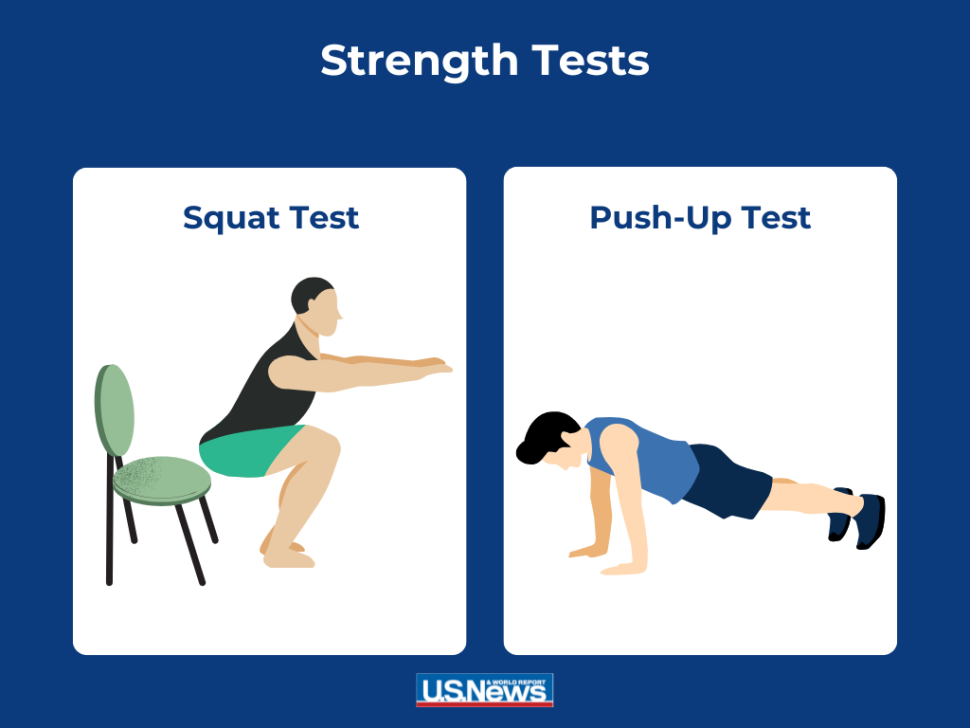
This test measures lower body strength and endurance.
To do the squat test:
| Gender and Age | Excellent | Average | Poor |
| Women 50-55 | 28 or more | 14 to 17 | 4 or less |
| Men 50-55 | 36 or more | 22 to 24 | 12 or less |
| Women 56-65 | 25 or more | 10 to 12 | 2 or less |
| Men 56-65 | 32 or more | 17 to 20 | 8 or less |
| Women 65+ | 24 or more | 11 to 13 | 1 or less |
| Men 65+ | 29 or more | 15 to 18 | 6 or less |
How to improve your results: If you’re performing below average for your age, consider adding a stretching routine to your activities. Do the full body stretching two to three times per week.
This measures your upper body strength and flexibility.
To do the push-up test:
| Gender and Age | Excellent | Good | Average | Poor |
| Women 50-59 | 29 or more | 15-29 | 6-14 | 2-5 |
| Men 50-59 | 34 or more | 25-34 | 15-24 | 8-14 |
| Women 60-69 | 19 or more | 5-19 | 3-4 | 1-2 |
| Men 60-69 | 29 or more | 20-29 | 10-19 | 5-9 |
How to improve your results: Add a combination of strength training exercises to your routine 2 to 3 times per week, resting for 24 to 48 hours between each session.
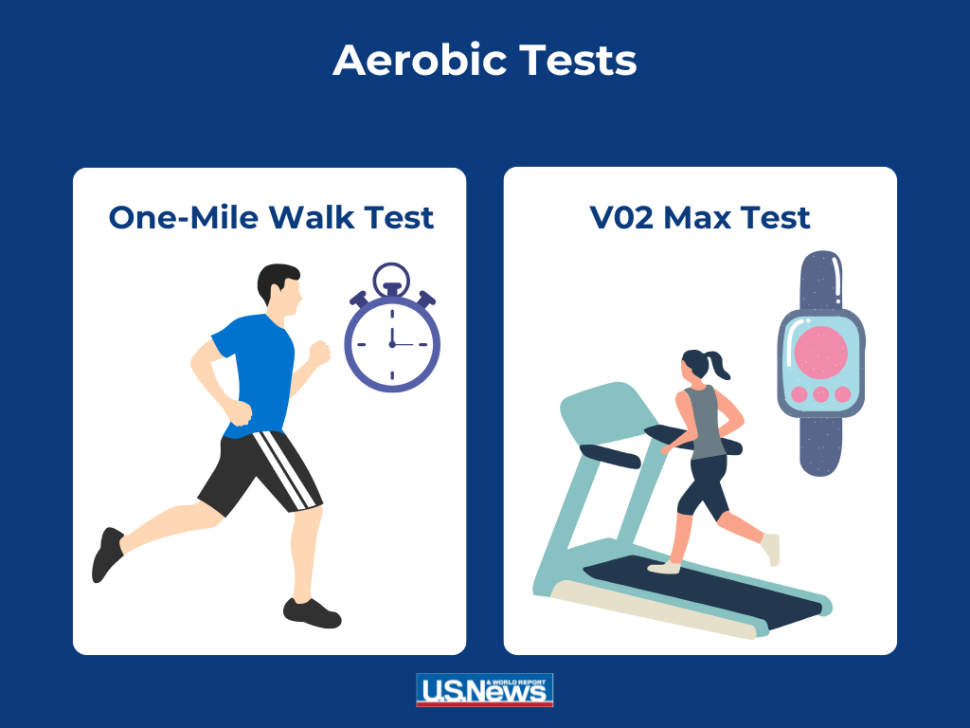
Aerobic fitness tests measure your cardiovascular health and fitness. These include activities like timing how long it takes you to walk a mile or measuring your heart rate during a workout. For example, VO2 max testing is a way of looking at the maximum volume of oxygen your body consumes during intense exercise. This measurement is generally considered the best indicator of cardiovascular fitness and aerobic endurance.
Studies have shown your walking pace is a good determination of your fitness level. Measuring how long it takes to walk a mile can give a rough indication of aerobic fitness, but it does not replace lab-based V02 max testing.
To do the 1-mile test:
| Gender and Age | Excellent | Good | Average | Fair | Poor |
| Women 50-59 | 14:42 or less | 14:42 to 15:36 | 15:37 to 17:00 | 17:01 to 18:06 | more than 18:07 |
| Men 50-59 | 13:24 or less | 13:24 to 14:24 | 14:25 to 15:12 | 15:13 to 16:30 | more than 16:30 |
| Women 60-69 | 15:06 or less | 15:06 to 16:18 | 16:19 to 17:30 | 17:31 to 19:12 | more than 19:12 |
| Men 60-69 | 14:06 or less | 14:06 to 15:12 | 15:13 to 16:18 | 16:19 to 17:18 | more than 17:18 |
| Women 70+ | 18:18 or less | 18:18 to 20:00 | 20:01 to 21:48 | 21:49 to 24:06 | more than 24:06 |
| Men 70+ | 15:06 or less | 15:06 to 15:48 | 15:49 to 18:48 | 18:49 to 20:18 | more than 20:18 |
How to improve your results: If walking a mile is difficult or the time is not in line with where you’d like your aerobic fitness levels to be, adding activities like walking, dancing, swimming, cycling and running are a few options to consider.
The VO2 max test evaluates your aerobic fitness and can provide an estimate of your cardiovascular health relative to age norms, but it is not a precise or diagnostic measurement. This test measures the amount of oxygen your body is able to utilize during high-intensity exercise.
To measure your VO2 max:
| Gender and Age | 10th Percentile | 25th Percentile | 50th Percentile | 75th Percentile | 90th Percentile | 95th Percentile |
| Women 50-59 | 17.3 | 19.9 | 23.4 | 27.6 | 32 | 35.9 |
| Men 50-59 | 22.8 | 27.1 | 32.6 | 39.7 | 45.6 | 50.7 |
| Women 60-69 | 14.6 | 17.2 | 20 | 23.8 | 27 | 29.4 |
| Men 60-69 | 19.8 | 23.7 | 28.2 | 34.5 | 40.3 | 43 |
| Women 70 and older | 13.6 | 15.6 | 18.3 | 20.8 | 23.1 | 24.1 |
| Men 70 and older | 17.1 | 20.4 | 24.4 | 30.4 | 36.6 | 39.7 |
How to improve your results: A high VO2 max indicates that your body is effectively and efficiently using oxygen during intense bouts of exercise and, therefore, is a measure of the level of your cardiovascular fitness and endurance. If your VO2 max is lower than recommended for your age group, consider making lifestyle adjustments or talking to a doctor about your health and fitness to help you improve over time. If you have already been tracking your VO2 max and notice that it has fallen over the years, this may not be a cause for concern. Consider your current benchmarks and try not to compare yourself to your younger self.
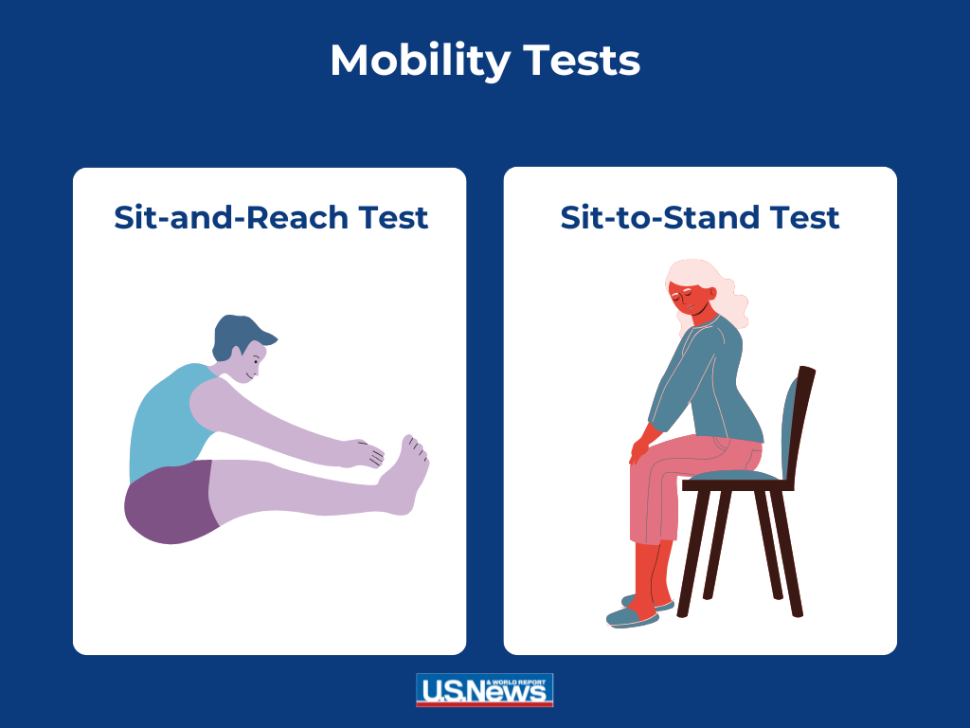
Mobility tests assess whether or not you can perform certain movements – like sitting on the ground and reaching for your toes – to give you an idea of how mobile and flexible you are.
This assessment helps to determine how flexible you are, especially in the lower back, hip and hamstrings.
To do the sit-and-reach test:
| Gender and Age | Average Score |
| Women 50-54 | 20 inches or more |
| Men 50-54 | 17.5 inches or more |
| Women 55-64 | 19 inches or more |
| Men 55-64 | 16.5 inches or more |
| Women 65+ | 17.5 inches or more |
| Men 65+ | 15.5 inches or more |
How to improve your results: Add 2-3 full body stretching sessions to your weekly movement schedule, including stretches for hamstrings, hips, calves, shoulders, neck and back.
This test assesses your strength and speed, along with your balance. It looks at how quickly you can stand up unassisted from a chair, sit down and repeat for 30 seconds.
To do the sit-to-stand test:
| Gender and Age | Average Score |
| Women 60-64 | 12 |
| Men 60-64 | 14 |
| Women 65-69 | 11 |
| Men 65-69 | 12 |
| Women 70-74 | 10 |
| Men 70-74 | 12 |
| Women 75-79 | 10 |
| Men 75-79 | 11 |
| Women 80-84 | 9 |
| Men 80-84 | 10 |
| Women 85-89 | 8 |
| Men 85-89 | 8 |
| Women 90-94 | 4 |
| Men 90-94 | 7 |
How to improve your results: In addition to using this test to evaluate your aging status, you can use it and similar motions to improve your strength. Lipov says that one of the primary movements he recommends that older people practice to improve their strength is getting in and out of a chair without assistance. By focusing on using your legs to lift yourself up, you can strengthen your lower body, he adds.
“If you can get the quads stronger, your chance of getting injured is much lower,” Lipov says. “If you have really strong quads, you’re not going to fall over.”
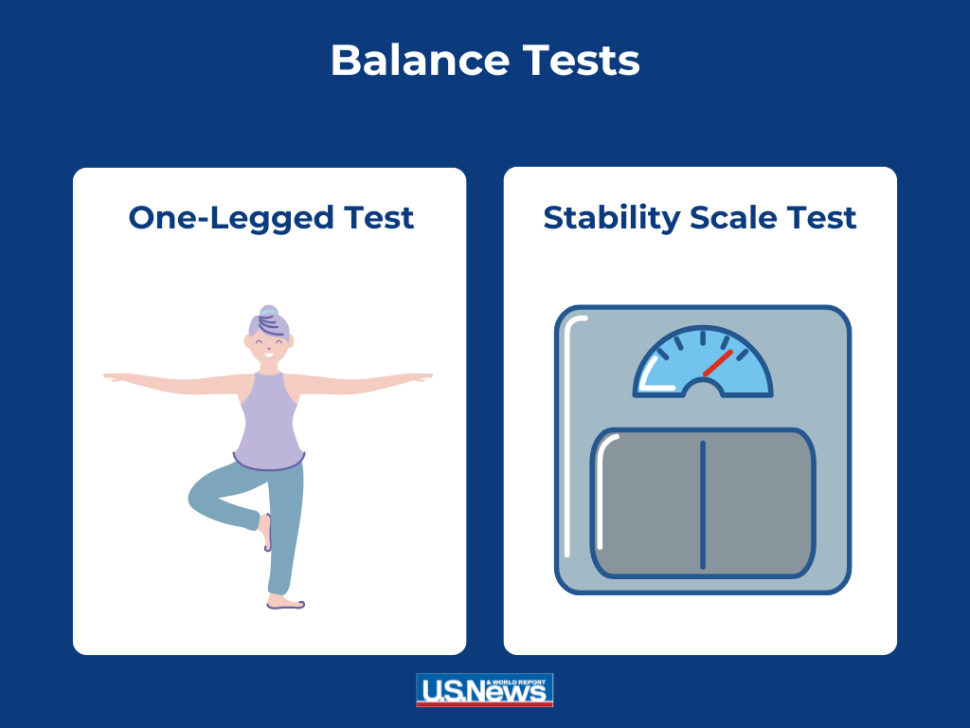
Evaluating your balance can give you insights into how well you are aging, and may provide information about other facets of your health.
“Balance is a holistic representation of your health,” says Katharine Forth, the CEO of ZIBRIO, a company that provides stability scales to assess people’s balance. “If something’s not right in the system, it gets expressed in your balance.”
Also known as the flamingo test, the one-legged balance test is a good at-home test to assess your balance and strength.
To conduct the one-legged balance test:
Desired score: If you are between the ages of 60 to 69, standing for at least 27 seconds is considered normal for your age. If you can stand longer, such as 30 seconds, that’s great, he adds. But if you can’t make it that long, or last as little as ten seconds, you should consider practicing to improve your score for the future.
How to improve the results: When it comes to using this test to evaluate how well you are aging, Lipov says the longer you can stand on one leg, the better.
“If they’re not stable, if they cannot stand on one foot, that means that either the muscles are weak, the brain is not working right or both,” Lipov adds. “Those are bad things, but you can start training (to improve) that. You can start exercising, standing by a wall and standing longer. You can assess it when there’s a problem, then you can do something about it.”
You can also test your balance by standing on special stability scales, such as those by Forth’s company ZIBRIO.
To conduct the stability scale test:
How to utilize the results: Getting a perfect 10 scale is almost impossible, Forth says, but you should still aim to get as high a score as possible. If you have a low score, however, it’s wise to avoid risky situations that put you at risk of falling throughout the day. You may also consider how you can improve your score later on, and if there are strengthening activities, lifestyle modifications or medical adjustments you can make to help you reach your goals.
“If your balance drops down, it’s a really great opportunity to go, ‘What’s going on with my body? Something’s not quite right,” Forth says. “You can (then) act on that a little bit earlier.”
She adds that sometimes, addressing your balance can be a good first step to help you address larger health ailments that might be plaguing you – that may feel too overwhelming to address, or that you may not be aware you are dealing with yet.
“Sometimes, balance is that easier topic to address because it doesn’t seem so scary or judgmental,” Forth says. “If you can make sure you’re doing things to get your balance right, then that’s going to make lots of other things right too.”
With any of these tests, by comparing your scores to recommended benchmarks for your sex and age group, you can determine what areas of your body are aging well for your age, and what areas you could work on.
Making positive changes to your aging and fitness tests is possible, and just because you are older doesn’t mean that you can’t thrive in the years to come. While your health goals may look different from what they did a few years ago, there are still impressive improvements that can have massive benefits on your well-being.
“Whether you’re 29, 39, 49 or 79,” Mandelbaum says, “the importance of aging well at every step is critical for all of us to get to our ultimate finish line, which is what longevity is about.”
It’s not just your physical body that changes with age, but your mind and cognitive function. Some cognitive challenges can be more common as you get older, and risks for cognitive diseases like dementia can increase, too. If you’re worried about your cognitive health as it relates to aging, it can be a good idea to talk to your doctor about getting a professional cognitive assessment. If you aren’t ready for medical help, you can conduct at-home tests as well.
Some at-home tests to evaluate your cognitive health include:
In addition to using cognitive tests to evaluate your age, you can use cognitive games to improve your brain function. Lipov recommends games like:
If you aren’t satisfied with test results thus far, or are simply looking for more data on your biological aging status, consider taking a blood test to evaluate your biological age.
These blood tests may sound appealing to people who are curious about their health, but they may not be the best idea for everyone. Because at-home blood testing can come at a couple hundred bucks a pop, it’s smart to consider if this is something you can afford before making the purchase.
“If I was going to put money into anything that has the highest input, I would do epigenetic testing,” Lipov says, adding it is smart to do one initial test and then check back in on your progress about five years later. “But you don’t have to.”
Additionally, you’ll want to have an honest conversation with yourself about whether or not you will use the results to better your health – which could make or break your investment. Cheaper alternatives, like getting a gym membership, prioritizing your sleep or shopping for more fruits and vegetables at the grocery store, can also do wonders for your biological age, Lipov says.
“Those are very simple, real things you can do,” he adds. “If you can improve your sleep, if you can exercise, eat better and make sure you don’t have a significant psychiatric condition, you’re gonna be fine.”
While many factors contribute to the aging process, some things to consider for overall well-being include:
Remember that you have the power to improve your biological age, even if the number isn’t where you would like it to be right now.
“The question is: do you want to live longer and are you interested in quality of life?” Lipov says. “If you’re not, then you probably don’t need to do anything, but you’re going to die sooner. If you are, you should optimize now – that trajectory should be changed as early as you can do it.”