

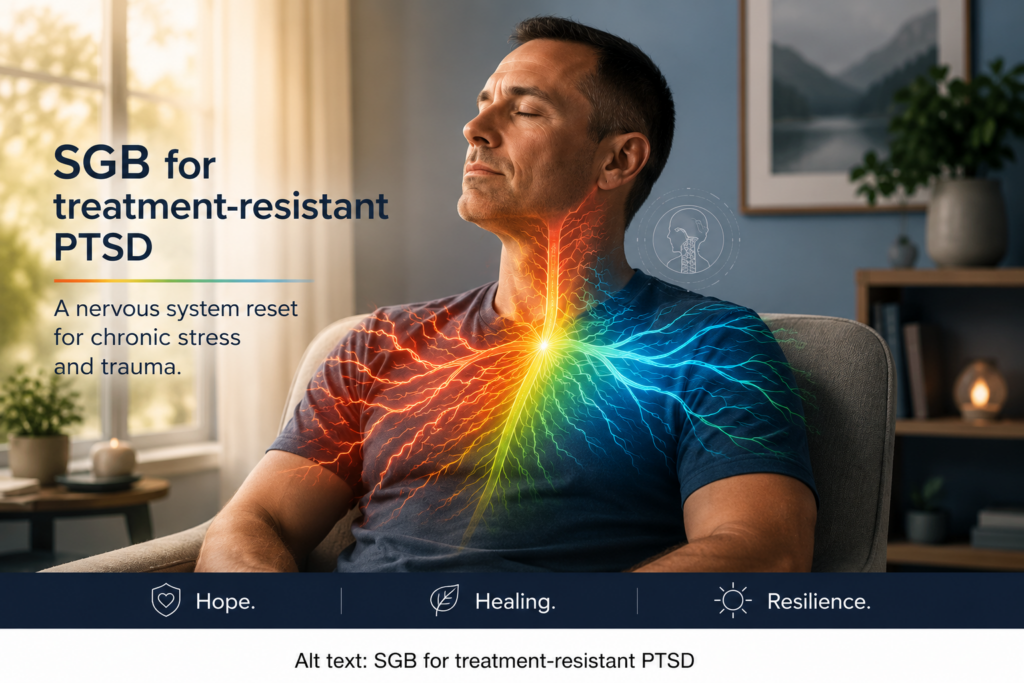
SGB for treatment-resistant PTSD often enters the conversation when people feel like they’ve already exhausted every option. Therapy may help for a while. Medication can soften some of the symptoms. Yet the body still stays on high alert, reacting to stress and fear as if the danger never truly disappeared.
There’s a quiet truth many clinicians don’t talk about: not every PTSD journey is fixed by the same tools.
For some, the missing piece isn’t “more therapy” or “stronger meds,” but something that changes how the body itself holds the past.
In recent years, a growing number of patients have found relief in a single, precise procedure: the stellate ganglion block (SGB).
And for those who’ve tried everything, SGB often feels less like a new treatment and more like a reset—something that finally lets the nervous system catch up with the mind.
What SGB can do when PTSD treatments stop working
When professionals talk about treatment‑resistant PTSD, they usually mean symptoms that persist despite multiple evidence‑based therapies and medications. Common patterns include: ncbi.nlm.nih
- Years of therapy that help with understanding, but not with the body’s panic response.
- Antidepressants or benzodiazepines dull the pain but also dull the person.
- Feeling “stuck” in hypervigilance: heart racing, muscles tense, nightmares returning, even when life on paper looks safer.
For patients like this, SGB offers a different kind of intervention. Instead of targeting thoughts or neurotransmitters alone, it temporarily quiets a cluster of nerves in the neck that heavily influences the “fight‑or‑flight” system. The goal isn’t to erase memories, but to reduce the intensity of the body’s automatic reaction to them.
Real‑world outcome studies and case series show that many patients report meaningful reductions in core PTSD symptoms after just one or two SGB sessions, even when prior treatments only partially eased their distress. That doesn’t mean everyone wakes up “cured,” but enough people notice a shift—calmer sleep, fewer flashbacks, more emotional stability—that it stops feeling like a last‑ditch experiment and starts feeling like a legitimate next step.
How SGB for treatment‑resistant PTSD creates a nervous system reset for chronic stress and trauma
The phrase “nervous system reset for chronic stress and trauma” is starting to show up not just in medical papers, but in patients’ own words. That’s noteworthy because most people don’t describe medical procedures in poetic language—unless the way it feels matches how it’s framed.
For complex PTSD and chronic stress, the body often stays in a prolonged state of arousal. The brain knows, logically, that the danger has passed, but the autonomic nervous system keeps pumping adrenaline, keeping muscles tight, heart rate elevated, and sleep shallow. SGB, when delivered carefully by an experienced provider like Dr. Eugene Lipov, can interrupt that loop for a time.
Here’s the non‑technical version:
SGB uses a small, targeted injection near the stellate ganglion, a relay station in the sympathetic nervous system. When the local anesthetic reaches that point, it briefly dampens the constant “on” signal that’s been feeding hypervigilance, panic, and physical tension. The mind doesn’t get wiped out. The trauma doesn’t disappear. But the body’s emergency response can quiet down enough to feel safer, more grounded, and more open to change.
For people whose nervous systems have been “on red alert” for years, that space—where the background hum of panic goes down—can feel like a kind of reset. They may still remember the events, but they no longer feel like they are living inside them every waking hour.
SGB for Treatment-Resistant PTSD and the Nervous System Reset Conversation
First responders—police officers, firefighters, EMTs, and paramedics—often work in environments where toughness is expected and emotional exhaustion is pushed aside. For many, SGB for treatment-resistant PTSD becomes part of the conversation only after years of trying to function through nightmares, hypervigilance, emotional numbness, anger, and chronic sleep disruption. Admitting that trauma has taken a toll can feel difficult in professions built around staying composed under pressure.
Traditional PTSD treatment can also feel overwhelming for first responders already carrying intense schedules and emotional burnout. Therapy appointments, medication adjustments, paperwork, and department requirements can start to feel like another burden to manage. That’s one reason why SGB for treatment-resistant PTSD has gained attention among first responders and veterans alike. Rather than focusing only on emotional processing, the procedure is often discussed as a way to calm the body’s fight-or-flight response and reduce the constant sense of being “on alert.”
Many first responders who explore SGB for treatment-resistant PTSD describe wanting relief from the physical side of trauma just as much as the emotional side. Early reports and provider observations suggest some patients notice better sleep, fewer panic reactions, reduced anxiety, and a calmer nervous system after treatment. While it is not considered a standalone cure, some clinicians now view SGB for treatment-resistant PTSD as part of a broader recovery plan that may help people engage more effectively with therapy, relationships, and day-to-day life again.
SGB‑assisted trauma‑focused therapy, and SGB for treatment‑resistant PTSD
Psychotherapy, especially trauma-focused approaches like prolonged exposure therapy or cognitive processing therapy, has strong evidence behind it. But for many people living with SGB for treatment-resistant PTSD symptoms, the hardest part is not understanding the trauma. It’s surviving the constant physical alarm that comes with it. The nervous system stays stuck in survival mode, and the body continues reacting as if danger is still present.
This is where SGB for treatment-resistant PTSD is increasingly being discussed alongside trauma-focused therapy. Instead of replacing counseling or emotional processing, some clinicians use SGB as a supportive tool that may help calm the body first. The thinking behind SGB for treatment-resistant PTSD is straightforward: when the fight-or-flight response becomes less intense, people may find it easier to participate in therapy without becoming emotionally overwhelmed or shutting down completely.
Recent pilot programs and emerging research involving SGB for treatment-resistant PTSD suggest that combining SGB with exposure-based therapy may help some patients engage more consistently with treatment. In some reported cases, people who previously froze during therapy sessions or avoided difficult conversations were able to stay present longer, sleep better afterward, and return to future sessions with less emotional exhaustion. That calmer physical state may create a more manageable environment for long-term recovery work.
At the same time, clinicians continue to emphasize that SGB for treatment-resistant PTSD is not viewed as a cure or replacement for psychotherapy. Therapy still plays a central role in addressing grief, fear, memory processing, and emotional healing. What SGB may do is change the conditions under which therapy happens. For people who feel trapped in chronic hypervigilance and stress responses, SGB for treatment-resistant PTSD can become part of a broader recovery strategy that supports both the body and the mind together.
Who might benefit from SGB, and what to realistically expect
SGB isn’t a universal fit, and it’s not risk‑free. It’s a medical procedure performed on the neck, and like any invasive intervention, it carries potential side effects such as voice changes, temporary eye drooping, or soreness at the injection site, though these are usually short‑lived when performed by experienced providers. Serious complications are rare, but they do exist, which is why careful screening and follow‑up are essential.
People who may benefit most from SGB include:
- Those who meet the criteria for treatment‑resistant PTSD after adequate trials of evidence‑based therapy and medication.
- Individuals whose symptoms are dominated by physical signs of stress: panic, heart pounding, insomnia, muscle tension, and emotional outbursts.
- Patients already engaged in or willing to engage in trauma‑focused therapy, since SGB and therapy can work as a complementary pair.
Realistic expectations matter. SGB doesn’t guarantee that PTSD will vanish. It can help reduce the intensity of symptoms, improve sleep, and create a more stable internal environment in which other treatments have a better chance to work. For some patients, one session is enough to notice a meaningful shift. For others, two or more sessions, spaced out over time, are needed to maintain the effect.
When SGB fits into a larger PTSD recovery plan
For many, SGB becomes part of a larger story of recovery, not the whole story. It’s one tool that can help when other PTSD treatments have left gaps—especially in how the body holds onto the past.
If someone has already tried therapy, medication, lifestyle changes, and still feels like their nervous system is running on fumes, SGB may be worth exploring. It’s not a shortcut, and it’s not a cure, but for some, it can be the quiet turning point where the body finally gets a chance to slow down, rest, and heal.
Those interested in whether SGB for treatment‑resistant PTSD, SGB for first responders and PTSD, or SGB‑assisted trauma‑focused therapy might fit their situation can learn more about how this type of intervention is used in practice at Dr. Eugene Lipov’s site on SGB for PTSD treatment. For a broader medical context, reputable sources like the VA Health Services Research & Development brief on SGB effectiveness provide additional background on real‑world outcomes.